
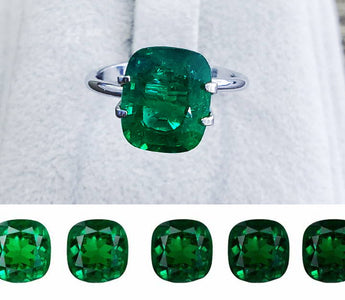
Choosing emerald? A guide to grading green gemstone color, clarity, treatment, and origin.
Emerald, also known as Emerald, is often referred to as the green gemstone in Hong Kong. Whether an emerald is good or beautiful can first be assessed by whether the color is visually appealing, and then by whether the style suits one's wearing style. If you want to further understand the grading of emeralds, you can start from its color, clarity, weight, treatment, and origin.
If you are preparing to purchase an emerald ring, pendant, or custom jewelry, you can also browse WILLS JEWELLERY Emerald jewelry page first, and then refer to the following rating factors.
How does emerald color affect value?
The color of emerald is an important factor affecting its price. It can generally be simply divided into light green, bright green, vivid green, and dark green. Among these, bright green and vivid green are usually more popular in the market, but it does not mean that deeper colors are necessarily better.
Certain professional certification organizations, such as GemResearch Swisslab AG, classify "Muzo Green" as a high grade among emerald colors. Muzo Green typically refers to a level of color saturation and brightness that reaches Vivid Green, meaning the green is pure, rich, and vibrant.
However, Muzo Green is not simply a color name. It usually also needs to meet criteria for origin, cutting quality, clarity, and other conditions. Due to strict conditions, some organizations in the market have proposed the "Verdant Green" color standard, referring to emeralds that achieve bright green color and high-quality visual effects, regardless of origin.
Example of an emerald certification report reaching Muzo Green color level. Image source: GRS
With years of experience in the colored gemstone and jewelry market, WILLS JEWELLERY believes that the highest-rated colors on the market may not necessarily be the favorite colors of every customer. The depth, brightness, and overall appearance of emerald color often depend on personal preference, wearing occasions, and the design of the jewelry itself. We believe: the green that suits you is the most suitable green.
To compare different tones, styles, and wearing purposes of emerald pieces, you can browse WILLS JEWELLERY Emerald jewelry pieces . We will assist customers in selecting suitable emerald rings, pendants, or custom jewelry based on color, light perception, Jardin, cutting proportions, and wearing purposes.
The color tone chart for green gemstones defined by GIA can distinguish the brightness of gemstone colors, but it does not mean that darker colors are better. Image source: EMCO, Fine Colombian Emeralds
Common emerald hues can be divided into pure green, yellow-green, and blue-green. Image source: Gemewizard
Emerald clarity and natural Jardin fingerprint
Clarity is one of the important indicators for evaluating emeralds, but the way clarity is judged for emeralds differs from that for diamonds. Diamonds are often strictly graded based on flaws seen under a tenfold magnifier, while emeralds place more emphasis on the overall aesthetic, transparency, and distribution of inclusions observed with the naked eye.
Emeralds naturally have more inclusions than many gemstones, and these natural inclusions are sometimes referred to as Jardin, or the "garden fingerprint" of emerald. Therefore, it is generally believed in the industry that the impact of clarity on emerald prices is usually not as direct as that of color.
Most natural emeralds on the market will have inclusions to some extent. If an emerald has no visible inclusions to the naked eye, there are usually a few possibilities: one is that it is a very rare and extremely high-priced natural high-quality emerald; two is that it has undergone some treatment; three is that one needs to be careful to confirm whether it is another green gemstone or a counterfeit.
Natural emeralds mostly contain inclusions visible to the naked eye or under magnification, commonly referred to in the industry as Jardin fingerprints. Image source: GIA
Emerald weight and carat number
Natural emerald crystals are generally not large, and high-quality, larger emeralds are relatively rare in the market. Generally speaking, emeralds over 8 carats are uncommon, while those over 10 carats with outstanding quality are even rarer collector's gems.
If the gemstone is cut in the emerald shape, the weight can sometimes be estimated from the gemstone's table and proportions. For example, counting outward from the gemstone's table, about 2 to 3 layers usually have a chance of falling within the 1 to 5 carat range; 3 to 4 layers may be close to 5 to 10 carats. However, the actual weight still needs to be measured accurately.
The weight of emeralds should be judged in conjunction with size, cut proportions, thickness, and actual carat weight.
Emerald treatment methods: What are the differences between oil injection, resin injection, and dyeing?
Common optimization or treatment methods for emeralds include: dyeing treatment, resin injection, colorless oil injection, coating treatment, etc. Among them, dyeing, coating, and resin injection are usually considered treatments and should be clearly disclosed during sales; while colorless oil or clarity enhancement treatment is a common optimization method in the emerald market.
Due to the natural presence of more cracks and inclusions in emeralds, many emeralds undergo oil or clarity enhancement treatment during the processes of mining, cutting, transportation, and sales. This practice is mainly to reduce the visibility of cracks, improve visual clarity, and to some extent protect the gemstone itself.
When purchasing emeralds, the most important thing is not simply to hear "is there any treatment," but to understand the treatment level, the substances used, whether the certificate description is clear, and whether the price matches the gemstone's conditions.
Visual comparison examples of emeralds before and after treatment. Image source: GIA
What are the differences between emeralds from Colombia, Zambia, and Brazil?
There are many places that produce emeralds, including Colombia, Brazil, Zambia, Russia, Zimbabwe, South Africa, and India. Among them, the most famous production area is Colombia, which is highly valued in the market for its long history and rich color.
However, origin is not the only standard for judging the value of emeralds. In recent years, Zambia and Brazil have also produced many high-quality emeralds. When purchasing, one should consider color, clarity, cut, treatment level, weight, and overall aesthetics, rather than just the name of the origin.
WILLS JEWELLERY's emerald gemstone grading
WILLS JEWELLERY is committed to providing professional colored gemstone and jewelry purchasing services. All emerald products will be accompanied by the store's gemstone grading, and some products even come with professional certification, detailing the characteristics of the selected natural gemstones, allowing customers to clearly understand the value and conditions of the jewelry they purchase.
With years of experience in selecting colored gemstones and custom jewelry, WILLS JEWELLERY assists customers in understanding the characteristics of each emerald from various aspects, including visual appearance, color saturation, transparency, inclusion distribution, cut proportions, origin characteristics, and oil treatment level.
Grading notes:
Cut: The facet polishing technique used by the craftsman.
Origin: The physical and gemological characteristics exhibited by the gemstone's origin.
Color depth: The inherent natural color concentration of the gemstone.
Color: The inherent natural color category of the gemstone, closely related to its origin and crystal conditions.
Inclusions: Minerals or growth traces naturally present in the gemstone that affect appearance and value.
Transparency: Affected by the density, distribution of inclusions, and the quality of the gemstone; the higher the transparency, the better it usually showcases light.
Oil treatment: A common optimization process for natural emeralds that can reduce the visibility of cracks, improve clarity appearance, and protect the gemstone.
WILLS JEWELLERY will provide customers with emerald jewelry purchasing advice based on gemstone conditions, design proportions, and wearing purposes.
Explore the WILLS JEWELLERY emerald jewelry page
From the color of the emerald, Jardin, origin, oil treatment level to the setting design, each piece has its own personality. Welcome to browse WILLS JEWELLERY emerald rings, pendants, and custom jewelry, or make an appointment to view in person.
Common questions about emeralds
Are emeralds and green gemstones the same type of gemstone?
Emerald, which is one of the most precious varieties in the beryl family. In everyday language in Hong Kong, some people refer to emeralds as green gemstones, but "green gemstone" can sometimes refer to other green gemstones as well, so it is recommended to confirm whether it is a natural emerald when purchasing.
Is a deeper emerald color always better?
Not necessarily. High-quality emeralds are characterized by rich, vivid colors that are not overly dark. A color that is too deep may affect brightness and transparency, so one should consider hue, saturation, brightness, and the actual appearance together.
Is it normal for natural emeralds to have inclusions?
Normal. Most natural emeralds will have varying degrees of inclusions, commonly referred to in the industry as Jardin or garden fingerprints. The key when purchasing is whether the inclusions affect the aesthetics, transparency, and durability.
Does oil treatment mean the emerald is not natural?
Not necessarily. Colorless oil treatment or clarity enhancement is a common and accepted optimization method in the emerald market, mainly used to reduce the visibility of cracks and protect the gemstone. However, treatments such as dyeing, coating, or resin injection need to be clearly disclosed.
What should I pay attention to when choosing an emerald ring?
When purchasing an emerald ring, in addition to color and clarity, one should also pay attention to the gemstone's durability, setting security, daily wearing habits, and whether it comes with clear grading or certification information. If for engagement or anniversary purposes, it is recommended to compare the actual color tone and light effect in-store.
More knowledge about emeralds and gemstones









%20selection%20knowledge%20and%20gemstone%20grading)