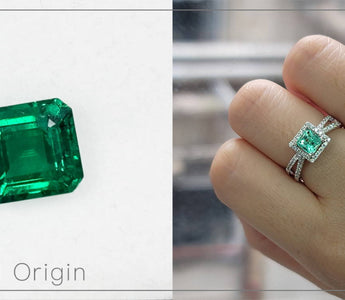
Many customers place great importance on the origin of emeralds when purchasing, especially Colombia and Zambia, which are the most well-known. What significance does the origin of emeralds have? What are the differences between emeralds from different origins?
1. Colombia
Colombia, as the largest source of emeralds, accounts for the majority of high-quality emeralds in the world market; the Chivor and Muzo mining areas are the two most famous emerald-producing mines in Colombia: the Chivor mine was developed as early as 1537, and the emeralds produced have a bluish tint, elongated crystals, and fewer inclusions, resulting in higher brightness and clarity than typical emeralds; the emeralds from the Muzo mining area are the most highly regarded, with shorter crystals but a higher color saturation. One type, known as "Muzo Green," is famous for its stringent conditions, requiring a deep green with an elusive blue light that is hard to imitate. If the color matches that of "Muzo Green," the authoritative certification body GRS will note MUZOGREEN or VIVID GREEN with an asterisk on the certificate's appendix. No other producing countries have been seen with comparable colors, highlighting the rarity of Colombian "Muzo Green" emeralds.
Left image: Emerald from Muzo mine, right image: Emerald from Chivor mine [Online Image]
2. Zambia
Zambia is the second largest producer of high-quality emeralds, with overall quality similar to Colombian emeralds; due to the higher iron content in the geological area, the emeralds produced are bright green or bluish-green, containing flaky biotite or prismatic hornblende inclusions, slightly grayish. The Mohs hardness of Zambian emeralds (7.5-8) is also higher than that of Colombian emeralds (7-7.5), making them suitable for cutting into smaller, high-quality gemstones.
Emerald from Zambia [Image Source: GIA]
3. Brazil
Brazil produces a variety of gemstones, including emeralds. Brazilian emeralds are generally lighter in color with a slight yellow tint and have more inclusions, mostly falling into the lower grade. However, in recent years, a large number of high-quality emeralds have been discovered, with inclusion characteristics similar to Colombian emeralds or even cleaner than Colombian ones. Due to their affordability and quality, they are becoming a major force in the market.
Emerald from Brazil [Image Source: GIA]
4. Others
Other sources of emerald include Afghanistan, Tanzania, Africa, and Yunnan, China, all of which have high-quality emeralds, but very few can enter the international gemstone market, which makes Colombian, Zambian, and Brazilian emeralds the international mainstream.
Emerald from Afghanistan [Image Source: M.S. Krzemnicki, SSEF]
Emerald from Yunnan, China [Image Source: Yang Hu, GIA]
Further Reading - Emerald and Tsavorite:
How can tsavorite be a substitute? A 1-minute distinction between "tsavorite" and "emerald" beauty
WILLS JEWELLERY's Gemstone Evaluation
WILLS JEWELLERY is committed to providing the most professional service to customers. All emerald products come with our store's gemstone evaluation, and some products even have professional certification that specifies the grading of the selected natural gemstones, allowing customers to clearly understand the characteristics of the gemstones they purchase, providing the best confidence guarantee.
Grading Notes
Cut: The facet polishing technique used by craftsmen
Origin: The physical characteristics exhibited by the gemstone's origin
Color Depth: The inherent natural color concentration of the gemstone
Color: The inherent natural color category of the gemstone, which is greatly related to its origin
Inclusions: Mineral substances naturally present in the gemstone that affect visual value
Transparency: Affected by the density and distribution of inclusions and the quality of the gemstone; the higher the transparency, the more fire the gemstone will display
Oil Treatment: A natural optimization process that reduces the visibility of internal cracks in the gemstone, enhances clarity, and protects the emerald
More Gemstone Knowledge
" Whether emerald (emerald) is good or beautiful can first be judged by whether you like the color, and then by whether the style appeals to you. If you want to learn more about emerald grading, you can start with its color, clarity......"
Emerald, one of the four internationally recognized gemstones (the four gemstones include emerald, ruby, sapphire, and diamond), but the geological conditions for the formation of emerald are more complex compared to ruby and sapphire...